

The performance and reliability of a solenoid, electric valve or electromagnet depend largely on a properly designed and manufactured coil. Winding of the solenoid coils has been our passion for almost 30 years – in this column, you’ll learn how to do it right!
The coil of a solenoid or electromagnet is the actuator responsible for generating the magnetic field necessary to move the core or plunger. Although its construction seems simple, the properties of the finished valve, solenoid, electromagnet, or relay depend on numerous design parameters and the quality of the winding process itself. In the case of solenoid valves, solenoids, relays, or electromagnets, even small deviations from the specified parameters can affect the attractive force, current draw, operating temperature, and durability of the entire device.
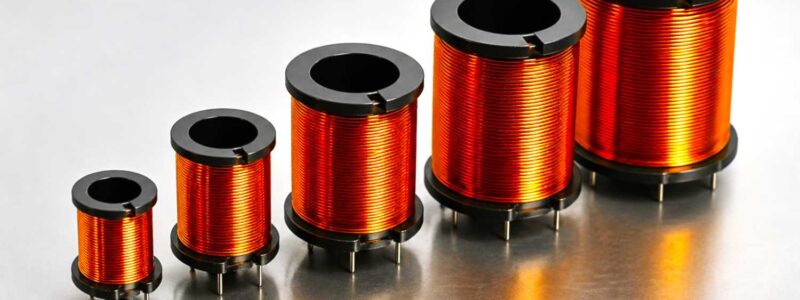
To clarify, when we talk about relay, solenoid, or electromagnet coils, we usually mean coils wound with thin wire (often less than 0.1 mm in diameter) and with a large number of turns (from hundreds to tens of thousands). Oh, and the coils are usually wound on bodies – as in the photos below. Are these the only possible designs? Of course not – every project is different. It is possible to wind self-supporting coils (without bodies at all) or even directly on cores (steel, ferrite or even aluminum)!

"Desired Outcome Vision" - sounds lofty, but it simply means your project.
The design of solenoid valves or electromagnets never begins with the winding. What we call the “goal vision” most often refers to the parameters of the intended application. The solenoid is supposed to “retract and extend,” usually with specific frequency, force, and stroke. Only after defining the basic assumptions do we move on to the details that interest us today: selecting the winding.
The selection of winding details begins once we have established a design framework – the specific application, supply voltage, current type (AC or DC), required electromagnet force, engagement time, and permissible operating temperature and humidity. Does your project have different requirements? Of course, it does – every project is different.
Based on the input data and the expected coil performance characteristics, its basic parameters are selected:
- Geometry
- Inductance
- Winding resistance (DCR)
- Maximum (continuous, instantaneous) current value,
- Winding wire diameter,
- Number of turns,
- Winding fill factor,
- Insulation class.
The solenoid coils designer must find a compromise between the magnetic field strength and the amount of heat generated. Using more turns increases the inductance, but also increases the winding resistance. Thicker wire, on the other hand, reduces power loss but limits the number of turns that can be accommodated in the available space.
The bobbin geometry and magnetic core material also play a significant role. These parameters influence the efficiency of the magnetic circuit and the final operating characteristics of the entire solenoid.
Solenoid Coils Winding: A Quality-Determining Process
Modern coil production at NEOTECH relies on automatic winding machines that provide full control over the number of turns, wire tension, and uniform winding layer placement – for example, the CNW-204 series winding machine, manufactured in-house by NEOTECH.
Proper wire routing is important not only for aesthetics but also, and above all, for the repeatability of electrical parameters.

The most intense activity occurs during production – the coil winding process. We say this is a key process for the final product quality. Therefore, the following parameters are monitored, among others:
- tension force – the tension of the winding wire,
- the winding arrangement on the coil former (layered, partially layered, or random),
- the number of turns per layer and the total number of turns.
The next inspection must take place after finalizing assembly. This is no longer about the condition of the winding, but rather about the compliance of the product or semi-finished product with the design specifications and technical drawing:
- fnished quality of the coil leads (wrapping, tinning, crimping, etc.),
- winding inductance and resistance,
- electrical continuity.
Is this the end of the process? No! Coil winding and preliminary assembly operations are just the beginning of the iceberg that is the entire production process of solenoids, solenoid valves, or electromagnets. Depending on the application, finished coils can be impregnated or encapsulated with resins, which increases resistance to moisture, vibration, and high temperatures. In industrial solutions, selecting the appropriate insulation class and materials resistant to contact with oils, grease, and other aggressive media is also crucial.

In-house production means greater control. That's why we've mastered winding of the solenoid coils!
Coil production requires not only appropriate machinery but also experience in winding design and knowledge of electromagnetic phenomena. Therefore, more and more device manufacturers are seeking partners who can not only manufacture the winding but also select its parameters for a specific application.
At NEOTECH Sp. z o.o., we manufacture electromagnetic coils in our own production facility, utilizing our own winding machines and technological facilities. This allows us to control the entire process – from winding design, through material selection and coil manufacturing, to final inspection of electrical parameters.
At our headquarters in Białystok, we custom-manufacture solenoid coils, coils for electric valves, electromagnets, relays, and all other actuators utilizing electromagnetism. Our in-house production capabilities facilitate the creation of both single prototypes and production runs, while maintaining high parameter repeatability and full quality control.
In the case of electromagnetic coils, precision manufacturing determines the reliability of the finished device. Properly designed windings, carefully selected materials, and a stable production process translate into long component life and consistent operation of the entire system.

Interested in contract coil winding? Looking for a subcontractor? Let's talk!
Each application and project poses different requirements regarding winding parameters, materials, and manufacturing technology.
At NEOTECH, we have mastered coil winding to perfection. We manufacture coils based on customer specifications or collaborate with you to develop solutions tailored to your specific application. If you are planning a new project or are looking for a proven manufacturer of electromagnetic coils, please contact our technical department.
