Handcrafted meets automated
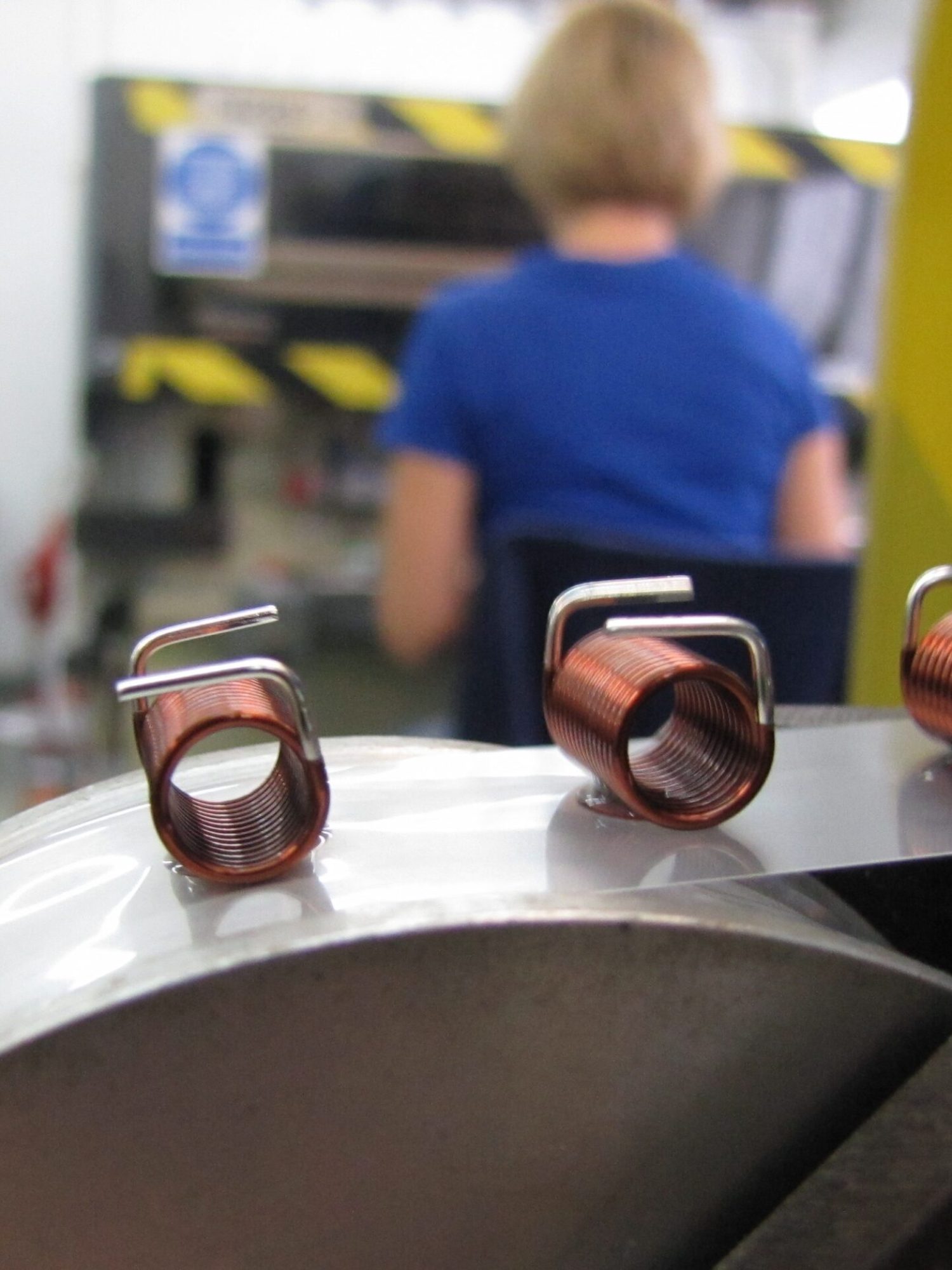
Imagine a small manufacturing company: a workshop with a few employees where coils are wound by hand. A skilled operator can sense the nuances of coil alignment and control wire guidance and tension. This is highly valuable for precision manufacturing. Unfortunately, this “manual finesse” comes at a price: productivity gains are limited by the physical capabilities of humans…
Let’s not forget about quality either – as operator fatigue increases, efficiency decreases, which translates into more frequent errors (defects, winding irregularities, damaged wire insulation) and a higher rejection rate of non-conforming products.
Above all, however, manual coil winding has a hard quantitative and productivity threshold. The time required to complete one product will depend on:
- the complexity level,
- winding time,
- the time for additional operations,
- the time for product inspection,
- the operator’s skill level.
Depending on the type of product, a skilled, full-time employee producing coils for 8 hours can wind only a few dozen to several hundred coils per day. With higher volume requirements, a crossroads arises:
- More people are needed. Possible. This solution means production efficiency is linearly related to the number of employees.
- Does the production technology need to be changed? Changing the product design (at NEOTECH, we call this technological advancement) will simplify the process and speed up production – but this is usually the customer’s decision, not the manufacturer’s.
- It’s necessary to invest in a machine. Maybe. But which one? And how much? And when will the investment pay off?
Full Automation: Efficiency, but at what cost?
Let’s estimate employee costs: the minimum wage in Germany today is around €2,500 gross (or around €30,000 per year). After adding in all employer overheads (taxes, insurance, overtime, bonuses), the real cost of one employee can reach €40,000–50,000 per year – or even more! Ten production specialists translate to €400,000–500,000 per year.
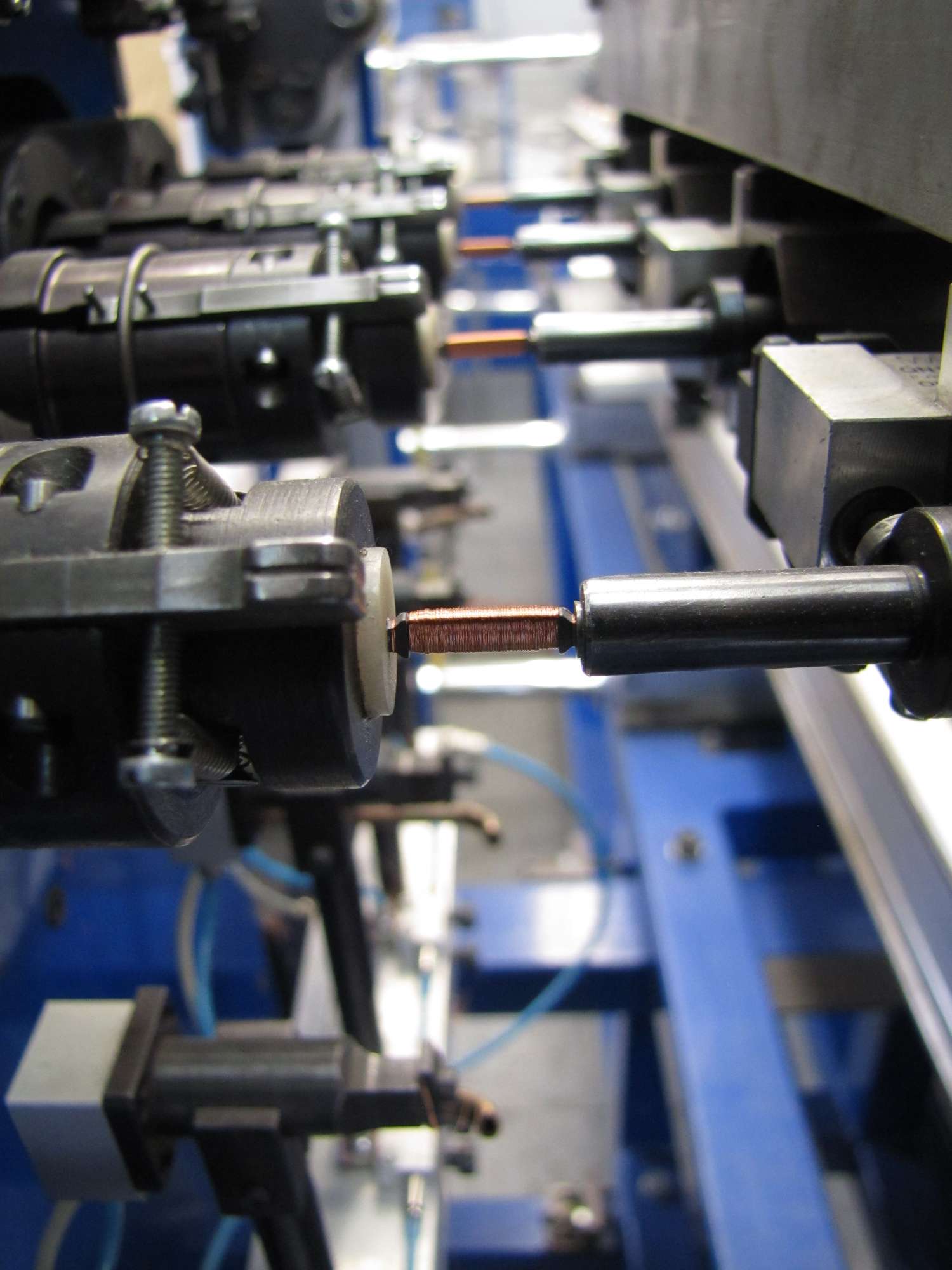
In manual production, the increase in demand for products means a proportional increase in employment. Automatic winders and production lines reverse this logic. Instead of workers, we have efficient machines with parallel or serial workstations, controlled by PLCs. The main advantages are well-known: efficiency, speed, repeatability, and continuous operation. For example, the comprehensive LAN-01 automatic winding line from NEOTECH, equipped with a 10-spindle CNW-204 winder, can produce up to approximately 1,000 inductive chokes per hour, or as many as 6,000-8,000 pieces per day (in a single shift). This is all with a single operator supervising the process and monitoring the quality of semi-finished and finished products. In practice, a single cell with such a machine can replace several manual workers. In comparison: where 10 people were previously required, now two or three are sufficient!
The efficiency of such a solution far surpasses manual labor (production of thousands of pieces per hour versus several hundred). The question is, what’s the catch? Achieving this level requires investment, a significant capital outlay. Advanced winding machines already require investments in the hundreds of thousands of euros. The simple conclusion is that automation will only pay off well with very large volumes. In exchange for the high cost of entry, we gain 24/7 operational continuity. At the appropriate scale of production, the total cost of ownership (TCO) of an automated line can be lower than the constant presence of employees and material replacement in a manual process. Some manufacturers will claim that additional advantages include near-zero material waste and quality above 99.9% (no manual errors). Anyone who has implemented such machines knows that things aren’t always perfect, but even so, at large volumes, automated production simply pays off.
Let's calculate profitability: When will the investment pay off?
A middle ground in winding machines is semi-automatic machines. For example, single- or multi-spindle machines where an employee performs only a portion of the operation. These typically cost tens of thousands of euros and represent a compromise – lower entry costs and possibly lower efficiency. However, at NEOTECH, we use such stations especially where the product’s complexity is sufficiently high to justify precise inspection of 100% of the workpieces by an experienced human operator.
The key question for decision-makers is: At what annual production level does the machine start to pay for itself? Mathematically, we can express this as follows: the investment in the machine should pay for itself within time T, i.e.:
T × annual savings ≥ machine cost
The machine will pay for itself after the following time:
T = machine cost / annual savings
After this time, we can “cut coupons” (well, not really 🤔 – more on that later).
For example, let’s assume a production line costing €250,000. Let’s also assume that this particular line can replace 5 workers with one. The annual cost of 5 workers (including all overheads): say €5 x €40,000 = €200,000/year. If the machine can replace four of these five workers (leaving, for example, one operator at €40,000/year), we save €160,000 annually. The payback time is €250/160 = €1.6 years! About 19 months. This is based on very simplified assumptions, but the strategy holds true: after just a few months, continued production translates into “pure profit” resulting from higher volume and lower fixed costs.
The truth is, however, that labor costs aren’t everything – machines also experience downtime, and over time, repairs and breakdowns. Recent experience also shows that various costs increase over time, extending the depreciation period. Alternatively, extending the machine’s depreciation period yourself will reduce product price premiums – something your customers will thank you for.
Our experience and case studies confirm that, with typical parameters, the ROI of automated lines is around 24 months. This is confirmed by a report from one supplier:
Customers typically achieve a full return on investment within one and a half to two years. After that, the machine generates a competitive advantage through faster deliveries and lower unit costs.
Conclusion: It's easy to trip up on the break-even point!
In practice, the break-even point cannot be calculated with a single, simple formula, as it will depend on specific project parameters:
- labor costs in a given factory,
- energy costs,
- product prices (e.g., coils),
- required quality, and
- the percentage of defects.
However, a general indicator can be the production volume in thousands of pieces per year. If we’re talking about tens of thousands of similar products per year, manual winding still holds its own. However, when volume increases to hundreds of thousands of products per year, a simple calculation shows that automation begins to dominate.
There is no exact threshold, but industry examples suggest that at around 100,000 pieces per year, the required number of employees and employment time make the investment cost of an automatic machine comparable to labor costs.