

In many workshops, coil winding is a simple task: select the wire diameter, then wind and count until the desired number of turns is achieved. However, this is misleading.
The delicate and complex task of coil winding has a significant impact on the final quality of the product. Even minor deviations can lead to costly consequences. As the Chinese say, “a minor defect quickly translates into losses, increased waste, or labor-intensive rework”.
The simplicity of the winding operation (number of turns, wire diameter) is deceptive – it’s a series of specific technological decisions, technology, and manufacturing precision, along with many invisible process parameters, that determine the coil’s electrical and mechanical properties! As we observed at NEOTECH over 25 years ago, designing inductive components is a process that requires precision and expertise. Every detail, from material selection to mechanical considerations, impacts the final quality.
What does coil winding involve?
1. Preparation for winding:
- Wire selection – material (copper, silver, etc.), diameter, and insulation. The wire cross-section determines the winding resistance. The type of insulation (insulation class) is also crucial, as it determines the maximum operating temperature and the resistance of the finished coil to environmental conditions.
- Coil carcass (core) geometry – the shape and dimensions of the winding form. Electrical parameters, primarily the coil’s inductance, depend nonlinearly on the number of turns and the dimensions of the coil body. The use of different cores (ferrite, steel, magnetic, non-magnetic) affects the maximum saturation current, losses, and frequency.
- Wire routing strategy – the winding does not always have to be neatly arranged in layers. Lifting solenoid coils are often wound in a “chaotic” manner. On the other hand, solenoid valve coils require precise control during winding and layering. Properly adjusted wire routing prevents tangling and uneven winding spacing. It also ensures optimal utilization of the winding space (high fill factor) and ensures consistent electrical parameters and geometry.
2. During winding:
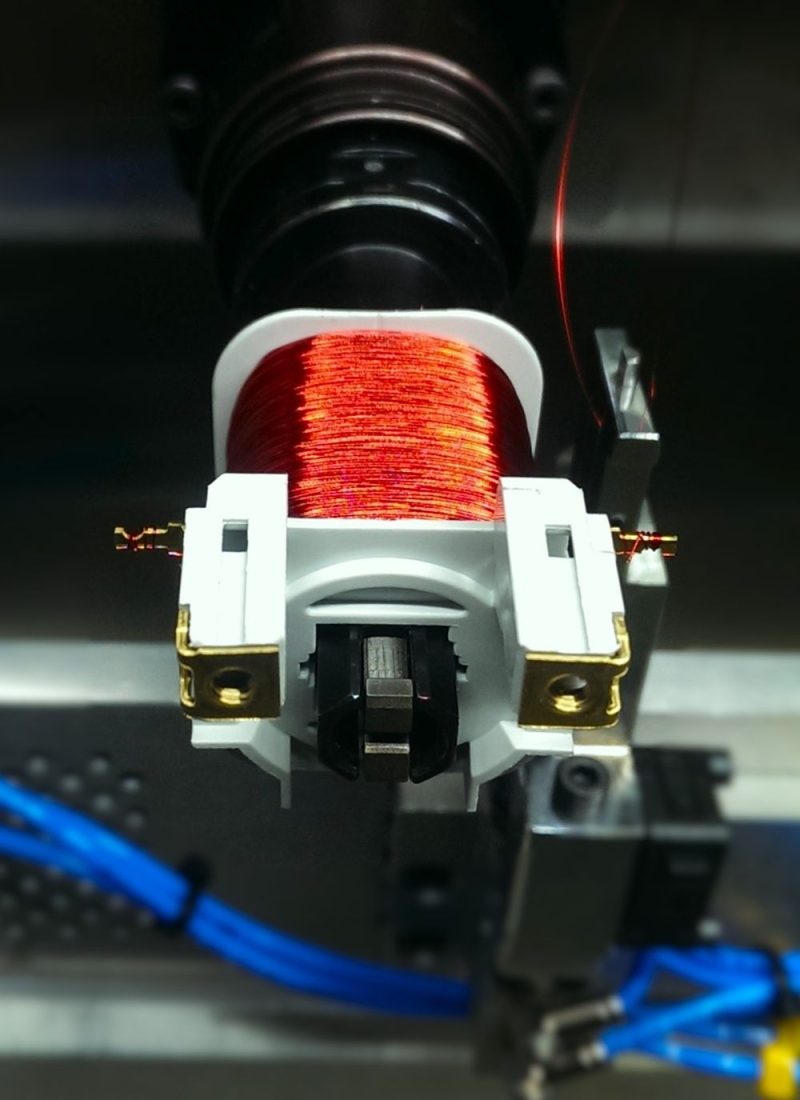
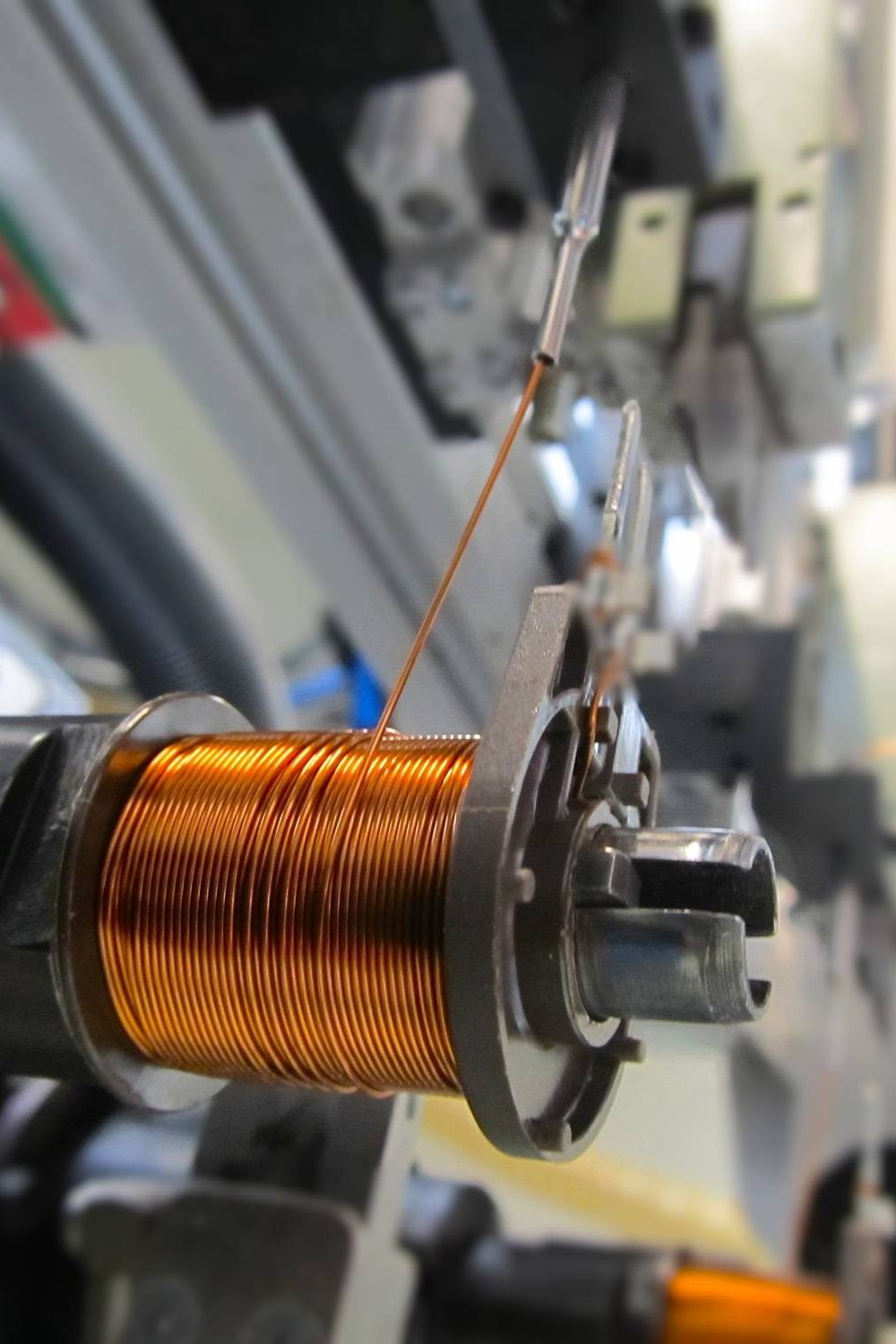
- Wire tension (tension) and winding stability – maintaining a constant tension force is the foundation of high-quality windings. Too low a wire tension during winding causes loose, shifting, and uneven layers (the “buzzing” effect), while too high a tension causes wire breaks or insulation damage. Modern systems (powder brakes, rollers, sensors) maintain the specified tension regardless of speed or changing spool diameter.
- Layer and transition control – replicating the planned wire path. Inaccurate guidance can cause overlapping turns or the formation of voids, which reduces the fill factor and increases heat loss. A precise guide mechanism helps prevent the “telescoping” effect and ensures uniform winding thickness.
- Winding terminations and protection – leads, housing, impregnation. Proper terminal mounting and insulation protect the coil from external factors (vibration, moisture, high temperature). Every detail – from the shape of the bent legs to the type of resin – affects the durability and resistance of the element.
# coil winding
Lots of parameters? Well, yes. But this only goes to show that winding is a web of technological interdependencies, not a simple, single operation! At NEOTECH, we believe that creating custom, complex, or precise windings requires a comprehensive approach. Only holistic optimization ensures repeatable results for our clients.
Main factors affecting quality and consistency (aka: Why is my winding not working as expected?)
In practice, it’s often not the materials that “spoil” a product, but rather the process factors. Many elements influence quality, but naturally, not all to the same degree. The most important include:
Variable tension is one of the main causes of defects. Our experience shows that stable and calibrated tension is the foundation of good winding. If wire tension changes (e.g., with decreasing spool diameter or brake wear) and is not controlled and compensated for, subsequent coil turns can become uneven, disrupt the windings, or even cause tangling and wire breaks. Maintaining proper tension also protects the enameled insulation from damage and cracks.
Even a slight shift in the wire guide (sometimes colloquially, and depending on the design, called a needle or roller) causes changes. Poor wire trajectory and feed results in overlapping coils or the formation of gaps or “holes” in the winding. Manual production often requires limited repeatability, but when it comes to automatic winding, stability is paramount. Machine movements must be repeatable over hundreds of cycles; any change in speed or acceleration generates a risk of error, especially when dealing with high volumes and speeds. Without a stable guide system, it’s difficult to achieve consistent windings from batch to batch.
Human labor provides flexibility for prototypes and small batches, but at the expense of repeatability and efficiency. Manual winders require a skilled operator and are slower. Computer-controlled automatic systems, on the other hand, ensure constant control of parameters (e.g., precision of the number of coils, repeatability of feed/guide movement) and eliminate some human error. As industry practice dictates, automation in mass production doesn’t always improve quality, but it certainly ensures the maintenance and stability of parameters.
Higher speeds allow for faster production, but impose stringent control requirements. Sudden acceleration or deceleration without precise tension control can introduce winding instability. Therefore, when designing the process, optimal motion profiles are selected, taking into account the characteristics of the wire and the given coil, ensuring that acceleration does not disrupt the achieved repeatability.
In summary, the biggest problems usually stem not from the wire itself, but from the intricacies of the winding process. Even the finest material won’t guarantee quality if tension control or machine precision fails.
# coil winding
Consequences of treating winding as an operation
Downplaying the process results in real business losses. In practice, this most often means:
Small differences in wire winding cause changes in inductance, resistance, or other critical properties. A series of coils may have wide variations in results rather than uniform values.
Winding deviations translate into poor reproducibility, leading to increased rejection rates and quality corrections. As the industry report notes, even a loose layer or broken wire can immediately generate higher scrap and rework costs.
An undocumented process is difficult to replicate at scale. As we attempt to scale up production, we encounter increasing drawbacks because manual tuning or undocumented practices don’t scale.
The inevitable shift toward machines and robotics requires defined and stable processes. An unprepared process must be manually corrected during production, which paradoxically increases the costs of automation. As experts summarize, without a solidly constructed process, even the most advanced machine will not deliver the expected quality.
Every coil rewind or faulty winding repair adds time and money. The more imperfections QC detects, the more production disruptions and losses occur. These repairs accumulate, reducing the overall profitability of the project.
Ultimately, a weak process prevents planned development. It becomes a bottleneck when faced with increased orders and complex new projects.
Mentally simplifying winding to a single operation leads to real threats: scattered results, reduced quality of the final devices and increased production and service costs.
# coil winding
Winding and automation – Why the process must be designed
We love automation. Watching a process grow from manual to automated production is pure joy, but adapting a product and process to automation is often not trivial – at NEOTECH, we specialize in this. Automation is key to increasing efficiency, but it won’t solve fundamental process errors. On the contrary, even the best machine won’t “catch up” to poor technology – without a stable process foundation, repeatable results are impossible. Therefore, designing and validating the process before implementing automation is a priority.
Originally, the machine should be selected to suit the specific product, not the other way around. The modern winders in our machinery are equipped with PLCs and software capable of implementing complex winding patterns and profiles. In practice, this means that the control system ensures that every product is identical, eliminating the most common sources of error. This allows the operator to focus on monitoring the entire process rather than making ad hoc parameter adjustments.
At NEOTECH, we manufacture both machines and inductive components locally in Białystok. This means we have a unique perspective: we know that the more demanding the coil (for example, with tight tolerances, a difficult design, or operating in demanding conditions), the more important a careful winding process is. Therefore, with every implementation, we strive to ensure the process is precisely planned and optimized – before we even start the automated production lines.
# coil winding
Coil, machine and process – one ecosystem
Thanks to our comprehensive approach, our clients can count on real, tangible benefits. By working with us – a single technology partner (who knows both the product and the necessary tools), the client significantly simplifies implementation and production. We can then be sure that the winder will be designed for the specific coil parameters, and the entire process (from wire, through the machine, to quality control) will be consistent. If production volumes are smaller and don’t justify the investment in a machine, we won’t force it on them – we know perfectly well that investing in new specialized equipment isn’t always possible. Instead, we offer winding at NEOTECH – using our own equipment and by our own employees. This saves you money on machinery and ensures you receive products of unparalleled quality!
Coil winding is much more than just rotor movement or assembly – it’s an investment in quality and future product development. A well-designed winding process ensures first-time performance, minimizes waste, and provides a foundation for further development (e.g., automation and larger batches). Therefore, remember: treating winding as an end-of-line operation risks losses and quality issues.
